The Intelligence Spectrum: 5 Ways Local Tech is Replacing the Giant Cloud
WDE Media
SEPTEMBER 27, 2026
For years, tech companies believed the best plan was “cloud-first”, sending every piece of data to massive, distant server warehouses owned by tech giants. But people are tired of the downsides: laggy loading wheels, apps that freeze when the internet flickers, and the fear of personal information traveling halfway around the world.
A new approach called edge-native architecture changes the game. Instead of relying on one giant computer brain miles away, computing power is split up. Everyday gadgets, from tiny factory sensors and phones to neighborhood servers, do the heavy lifting right where the action happens.
1. AI Power is a Sliding Scale, Not a One-Stop Shop
Computing is no longer an “all or nothing” choice between your phone and a mega-server. Instead, tech works like a relay team. Tasks are shared across five levels depending on how fast you need an answer and how much brainpower the job requires:
- Level 0 (Tiny Sensors): Micro-chips on factory machines or wearables. They respond in under 5 milliseconds (faster than the blink of an eye) to catch simple errors.
- Level 1 (Handheld Devices): Smartphones and tablets. They run snappy on-screen tasks in 20 to 80 milliseconds without needing Wi-Fi.
- Level 2 (Local Stations): Smart laptops and branch-office computers. They handle medium-sized chores, like summarizing a long document, in 15 to 50 milliseconds.
- Level 3 (City Hubs): Regional mini-data centers in nearby cities. They answer in 30 to 120 milliseconds for slightly heavier requests.
- Level 4 (Central Supercomputers): Massive warehouse clusters. Reserved for enormous projects that take longer but have virtually unlimited power.
Instead of sending your data to the AI, the AI lives right where your data starts.
2. “Middle-Weight” Brains: Doing More with Less
Old AI models were like giant encyclopedias: every time you asked a simple question, the system had to read every single page.
New designs use a Mixture of Experts method. Imagine a school where eight specialized tutors sit in a room, one for math, one for history, one for grammar, and so on. When you ask a math question, only the math tutor answers while the rest stay quiet.
By waking up only the specific “tutors” needed for each question, a phone or laptop can deliver brilliant answers using only a tiny fraction of battery and memory. If a question is too tough for your phone, the device seamlessly passes just that tricky problem up to a nearby workstation.
3. The Digital Fact-Checker: Stopping AI Hallucinations
AI sometimes invents facts with total confidence, a problem known as “hallucinating.” In self-driving cars or medical monitors, a made-up answer can cause real harm.
Edge-native systems solve this with an automated fact-checker:
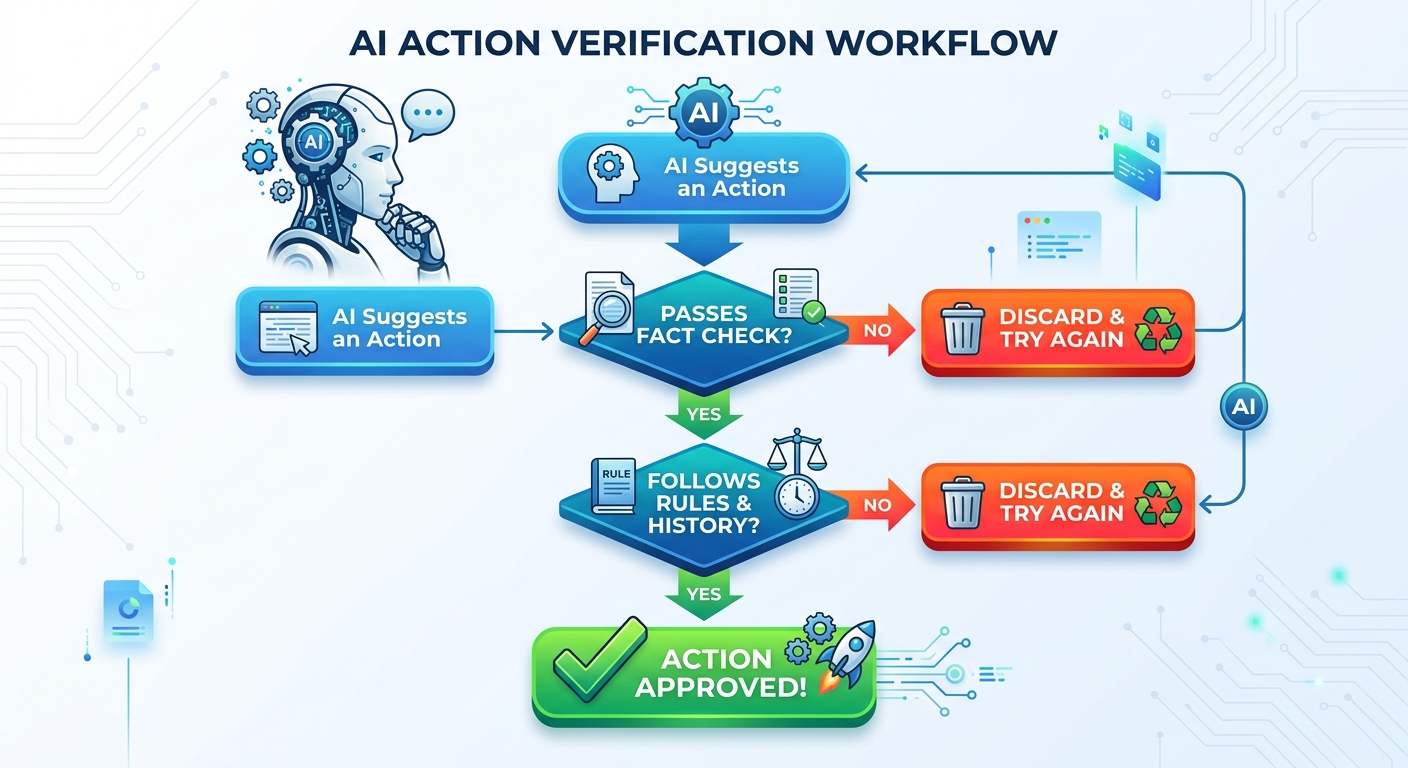
The system runs a two-step checkpoint before taking any action:
- Fact Check: Does this match verified, real-world data stored in the local records?
- Timeline Check: Does this make sense based on what just happened a second ago?
If an idea passes both tests, the action goes through. If it fails either test, the system blocks the action and tries again.
4. Privacy Without Borders
Different countries have strict privacy laws requiring personal records to stay within national borders. Companies used to build completely isolated networks for each region, which was clunky and expensive.
Modern edge networks split the delivery route from the lockbox:
The Lockbox Analogy: Think of sending an armored truck through international territory. The truck can use global highways to get where it needs to go fast, but the digital keys to open the doors stay locked inside the customer’s home country.
Even if network traffic passes through an outside server, nobody can open or read the data until it safely reaches an authorized facility in the approved country.
5. Offline-First: Never Losing Your Work
If you are working in a subway tunnel or a remote warehouse, expecting 100% internet access is unrealistic. Edge-native systems use a local-first design.
- Works Like a Shared Doc: It functions like Google Docs when your Wi-Fi cuts out. You keep typing, editing, and saving on your phone without interruption.
- Smart Merging: Your changes sit in a locked, encrypted outbox. When you walk back into Wi-Fi range, the device syncs with the main system.
- No Accidental Overwrites: Instead of erasing one person’s work with another’s, the system compares timestamps and neatly weaves both updates together.
The era of trusting everything to one distant cloud is ending. By letting gadgets think for themselves, verifying facts locally, and keeping data safely locked at home, the entire network turns into one fast, cooperative system that works even when the internet drops.